
Apache Camel 4.22 LTS has just been released.
This is a Long Term Support (LTS) release, which means it will receive patch releases with bug fixes and security updates for approximately one year. The supported LTS lines are now 4.18.x and 4.22.x (4.14.x reaches end of life with this release).
This release introduces a large set of new features and noticeable improvements that we will cover in this blog post.
The headline features in this release are:
- Camel TUI – A brand-new terminal application for monitoring, managing, and developing Camel integrations with 30+ tabs, built-in YAML DSL editor with Tab completion, AI assistant, and more. See the dedicated Camel TUI blog post.
- Camel CLI Installer – One-line install scripts for macOS/Linux and Windows, with self-update and doctor diagnostics. See the dedicated Camel CLI Launcher Installers blog post.
- Camel AI – A unified AI tool abstraction (
camel-ai-tool) and built-in MCP server let you define a tool once as a Camel route and use it with LangChain4j, Spring AI, and OpenAI – and expose it to any MCP-compatible AI agent. See the dedicated Camel Routes as AI Tools blog post. - Secure Out of the Box – Continued the security-by-default effort across the framework with JEP-290 deserialization filters, dynamic URI allow-lists, download containment, path traversal prevention, credential masking, and JWT hardening. Camel aims to be secure without extra configuration.
Camel Core
Splitter EIP Enhancements
The Splitter EIP has been enhanced with three new capabilities:
- Chunking – Process items in fixed-size batches with
chunkSize. - Error threshold – Stop splitting after N consecutive failures with
errorThreshold. - Watermark resume – Resume from the last successfully processed item with watermark tracking.
Virtual Thread Readiness
Continued the effort to replace synchronized blocks with ReentrantLock across dozens of components (OAuth, security, AI, telemetry, metrics, MLLP, and more), improving compatibility with virtual threads.
Secure Out of the Box
We continue the effort to make Camel secure by default, without requiring extra configuration. This release adds JEP-290 deserialization filters, dynamic URI allow-lists for toD and enrich, download containment for cloud storage consumers, path traversal prevention in tar/zip archives, header filter strategy fixes across more components, stronger credential masking in logs and URIs, and JWT authentication hardening for the embedded HTTP server. The goal is that Camel should be safe to run in production without needing to remember a checklist of security options to enable.
Camel TUI
The Camel TUI (Terminal User Interface) is a brand-new feature in Camel 4.22. It is a full-featured terminal application for monitoring, managing, and developing Camel integrations. See the dedicated Camel TUI blog post for an introduction and visual tour, and the Camel TUI Editor blog post for a closer look at the built-in YAML editor.
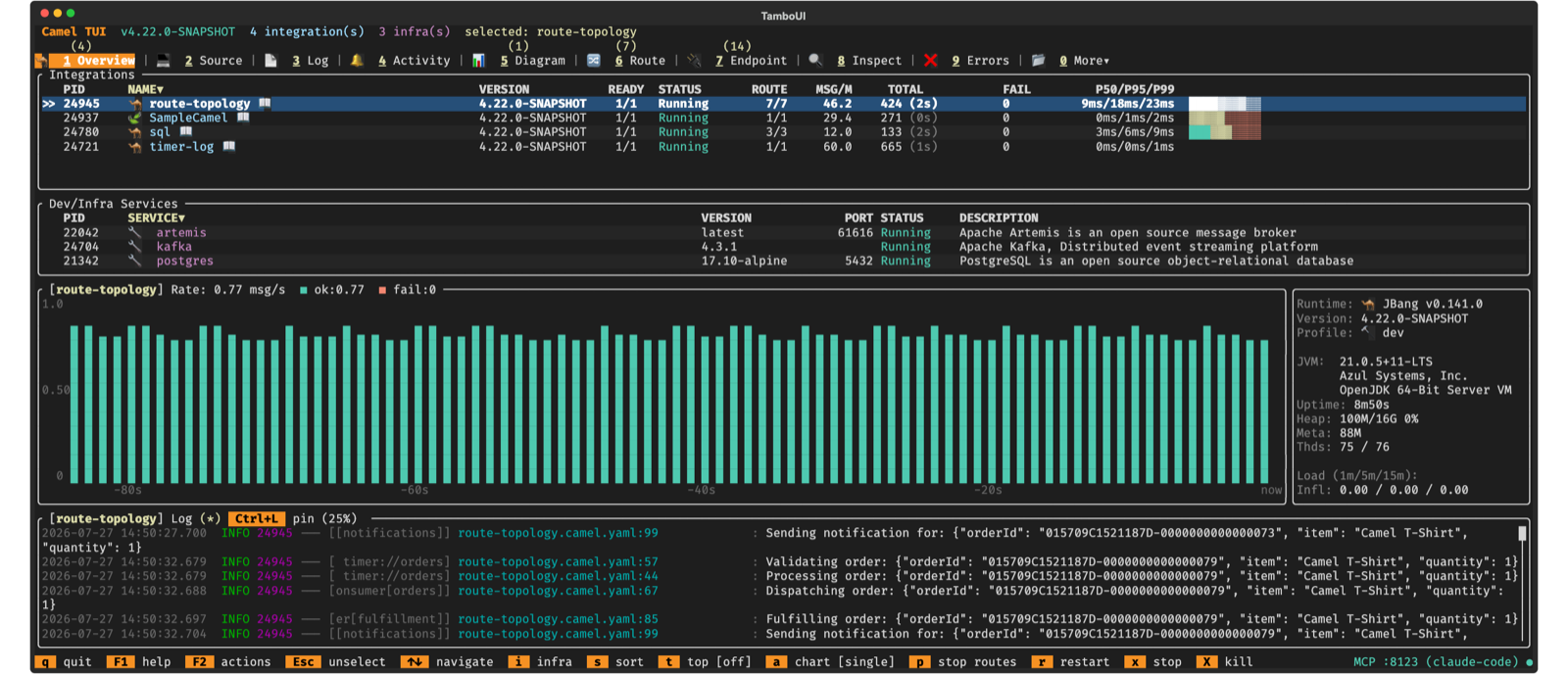
The TUI provides a rich set of tabs for observing your running Camel application: routes, endpoints, consumers, activity, errors, history, diagrams, health, OpenTelemetry spans, JFR profiling, heap analysis, CVE audit, catalog browsing, SQL queries, and much more – all from your terminal.
It also includes an embedded AI assistant panel (F8) with support for OpenAI, Azure OpenAI, Google Gemini, and IBM watsonx.ai.
Built-in YAML DSL Editor
The latest work on the TUI is a built-in source editor for Camel YAML DSL routes, with Tab completion for:
- EIP names and options
- Component names and endpoint options
application.propertiesconfiguration keys
The editor validates Camel YAML files and camel.* properties on save, showing errors inline. Combined with the inline quick-documentation viewer, you can develop and iterate on routes without leaving the terminal.
Camel CLI
The Camel CLI has been promoted from Preview to Stable support level.
Website Installers
Installing the Camel CLI is now as simple as a one-liner. See the dedicated Camel CLI Launcher Installers blog post for details.
Two canonical installer scripts are now available:
curl -fsSL https://camel.apache.org/install.sh | shirm https://camel.apache.org/install.ps1 | iexThe installers download from Maven Central, verify SHA-256 checksums, and validate that a Java 17+ runtime is available. Installation is always per-user and never requires sudo.
Self-Update and Doctor
camel self-update checks for and installs newer launcher releases. camel doctor now additionally reports every Camel CLI installation found on the machine across package managers, flagging conflicts.
OpenAPI UI
camel run --openapi-ui exposes Swagger UI for REST DSL OpenAPI at /q/openapi on the embedded HTTP server, making it easy to explore and test REST APIs during development.
Route Diagrams from Source Files
camel cmd route-diagram and camel cmd route-topology now accept source files directly, so diagrams can be generated at design time without starting the application:
camel cmd route-diagram routes/*.yaml
camel cmd route-topology routes/*.yaml
JFR Now Works
camel run --jfr now actually starts a Java Flight Recorder recording (previously the flag was accepted but had no effect). Camel runtime events (route, processor, exchange) are captured automatically.
Other CLI Improvements
camel export --parent-pomoption for custom parent POM.camel run --resource-dirsoption for additional resource directories.camel run --jvm-argsoption for custom JVM arguments.- Native
camel.exein the WinGet package (cross-compiled with llvm-mingw). - Azure OpenAI, Google Gemini, and IBM watsonx.ai support for
camel askand TUI F8 panel.
Camel AI
This release brings a major step forward for Camel’s AI integration story. See the dedicated Camel Routes as AI Tools blog post for a deep dive.
Unified AI Tool Component (camel-ai-tool)
A new camel-ai-tool component provides a unified way to define AI-callable tools as Camel routes, replacing both camel-langchain4j-tools (now deprecated) and camel-spring-ai-tools (now removed). Define a tool once, and it works with LangChain4j, Spring AI, OpenAI, and any MCP-compatible AI agent:
from("ai-tool:weather?tags=weather&description=Get weather¶meter.city=string")
.setBody(constant("{\"city\": \"Paris\", \"temp\": \"22C\"}"));The AiToolRegistry listener SPI notifies consumers when tools are added or removed, and argSchema supports raw JSON Schema for complex tool parameter definitions.
Built-in MCP Server
The MCP server can now be embedded directly in your Camel application (Main, Spring Boot, or Quarkus). The McpServerBridge watches the AiToolRegistry and exposes matching tools over the MCP protocol, so any MCP-compatible AI agent can discover and call them. Tags control which tools are visible to external clients.
Camel OpenAI
The camel-openai component gained several new capabilities:
- Responses API – A new
openai:responsesoperation calls the OpenAI Responses API with support for text/image input, structured output, server-side multi-turn state, and hosted tools (web_search,file_search,code_interpreter). - Audio speech and translation – New operations for text-to-speech and audio translation.
- Parallel MCP tool execution – Execute multiple tool calls from a single LLM response concurrently.
- MCP tool refresh – The agentic loop now subscribes to
tools/list_changednotifications and refreshes the tool list automatically, as the MCP specification expects. - Configurable error strategies – Control how tool execution errors and hallucinated tool names are handled (
failExchangeorrepromptModel). - Token budget enforcement – A
maxToolCallingRoundTripslimit (default 10) prevents runaway tool-calling loops.
Camel MCP Server
The Camel MCP Server has been promoted from Preview to Stable support level.
The MCP server can now be embedded directly in camel run, camel dev, and Camel Main applications via camel.server.mcp-* configuration properties and the new McpServerEngine SPI with a Vert.x-based implementation. See the Camel Routes as AI Tools blog post for the full architecture.
Camel JBang MCP Server
The standalone Camel JBang MCP Server (used by AI coding assistants like Claude Code) also received significant improvements:
- Security-first execution layer – validates tool invocations and protects against unauthorized access.
- Route cost estimation –
camel_route_cost_estimateestimates the cost of running a route with a given LLM. - Dependency security audit –
camel_dependency_security_auditaudits dependencies for vulnerabilities. - Security scan –
camel_security_scananalyzes routes for security concerns. - AI pipeline scaffold –
camel_ai_pipeline_scaffoldscaffolds an AI pipeline from a description. - Full documentation – retrieve full AsciiDoc documentation from the catalog.
- CVE advisories – published Camel CVE security advisories are now part of the catalog.
- Session management – keep-alive pings and idle TTL eviction prevent orphaned sessions.
Observability
Percentile Latency Statistics
Camel now tracks percentile latency statistics (p50, p95, p99) on the base performance counters. These are available via JMX, the dev console, the TUI, and the CLI. The throughput MBean attribute also now uses EWMA (exponentially weighted moving average) smoothing for more stable readings.
JFR Runtime Instrumentation
camel-jfr can now emit JFR events during message routing (opt-in with camel.main.startup-recorder-runtime-enabled=true), not just at startup. This enables runtime profiling of route execution with standard Java Flight Recorder tooling.
SQL Trace Dev Console
A new SQL Trace dev console captures and displays SQL queries executed by Camel routes, visible in the TUI, CLI, and through the dev console API.
Heap Histogram
A new heap histogram dev console and TUI panel shows instance counts and byte usage per class, useful for diagnosing memory issues.
Google Cloud Span Decorators
New span decorators for Google Cloud AI/ML, messaging, and storage components provide richer trace context for Google Cloud service calls.
Camel Kafka
Correctness Fixes
This release includes a major correctness fix campaign for the Kafka component:
- Manual commit fix –
allowManualCommit=trueno longer auto-commits offsets; only explicitKafkaManualCommit.commit()calls commit. - Batch auto-commit fix – Fixed the batching consumer committing unprocessed offsets.
- saslAuthType fix – Generated SASL configuration no longer overrides explicit settings.
- Producer scalar nodes – Scalar Jackson
ValueNodebodies are no longer silently dropped. - Auto-generated groupId – Now shared across all consumer threads (previously each thread got its own UUID, causing duplicate processing).
Batch Exchange Headers
The batch exchange now carries CamelKafkaTopic and CamelKafkaPartition headers when all records in the batch share the same value.
Unified Reconnection Task
The consumer’s reconnection logic is now a single background task visible in TUI, CLI, and management tooling.
Camel Spring Boot
MCP Server Starter
A new camel-mcp-server-starter integrates the Camel MCP server bridge with Spring AI’s MCP server. Camel route tools defined with ai-tool: are automatically exposed alongside Spring AI’s native @McpTool beans on the same MCP server, with no extra wiring needed.
Platform HTTP Starter Hardening
The camel-platform-http-starter received a batch of fixes aligning it with Spring Boot 4 idioms: Spring MVC mappings are now unregistered when a route stops, executor ownership and exchange lifecycle are corrected, httpMethodRestrict no longer silently widens to all methods on unparsable verbs, and the CookieHandler contract is properly honored.
Profile Support
Configuring camel.main.profile via Spring Boot properties now works correctly, so you can set camel.main.profile=prod in application.properties to activate the production security profile.
Spring AI 2.0
The camel-spring-ai-* components have been upgraded to Spring AI 2.0, which targets Spring Boot 4.1 and Spring Framework 7, aligning with Camel’s current baseline.
Observability Defaults
Observability services defaults are now shipped via an EnvironmentPostProcessor, enabling zero-config metrics and tracing when the observability infrastructure stack is running.
Circuit Breaker EIP
The Circuit Breaker EIP received a modernization effort:
- Resilience4j duration options now accept Camel duration expressions (
60s,1m,PT1M) alongside plain millisecond values, and async (non-blocking) processing is now supported. - Fault Tolerance gained live call counters (successful, failed, not-permitted) and a
transitionToCloseStateJMX operation. - Multiple correctness fixes for timeout handling, exchange property preservation, and state management during suspend/resume.
onFallbackViaNetwork()has been deprecated (it was never supported by any current implementation).
New Components
camel-ai-tool– Unified AI tool definition component for LangChain4j, Spring AI, and OpenAI.camel-clickhouse– ClickHouse column-oriented database integration.camel-duckdb– DuckDB embedded analytics database.
New Language
camel-jactl– Jactl scripting language for Camel routes.
Test Infrastructure
New Modules
Four new test-infra modules have been added:
camel-test-infra-clickhouse– ClickHouse database.camel-test-infra-cyberark-vault– CyberArk Conjur vault.camel-test-infra-duckdb– DuckDB embedded analytics database.camel-test-infra-observability– Observability stack (Prometheus, VictoriaTraces, VictoriaLogs, Perses).
Web Consoles
Infrastructure services started with camel infra run now expose web console URLs when available (e.g. Kafka UI, management consoles). The URLs are shown as clickable hyperlinks in the TUI and CLI, making it easy to jump straight to the admin UI of the service you just started.
Observability Stack
A new observability infrastructure stack is available with camel infra run observability. It bundles Prometheus, VictoriaTraces, VictoriaLogs, and Perses (dashboard) for out-of-the-box metrics, distributed tracing, and log aggregation during development. Combined with --observe on camel run, zero configuration is needed – Camel automatically scrapes metrics and exports traces and logs to the running stack.
Other Notable Changes
camel-awsmodules migrated fromapache-clienttoapache5-client(Apache HttpClient 5).camel-aws-bedrockgainedinvokeAgentandinvokeInlineAgentoperations.camel-aws2-transcribeimplements all 21 declared operations (previously stubbed).camel-debeziumupgraded to 3.6.camel-keycloakgained federated identity linking, audience validation, and token type validation.camel-minioupgraded to 9.x with several API breaking changes.camel-opensearchgainedOpenSearchClientas a component option.camel-pqcnow uses authenticated encryption (AEAD) instead of unauthenticated ECB mode.camel-wasmmigrated from Chicory to Endive for WebAssembly execution.camel-weaviateupgraded to client v6 with new operations (BATCH_CREATE, HYBRID_QUERY, BM25_QUERY, AGGREGATE).camel-xmppupgraded Smack from 4.3.5 to 4.4.8.- IBM MQ client upgraded to 10.0 with JMS vendor property handling fix.
- Massive flaky test fix campaign – over 50 flaky tests stabilized across the test suite.
- Upgraded many third-party dependencies to latest releases.
Deprecated Components
camel-langchain4j-tools– Usecamel-ai-tool+camel-langchain4j-agentinstead.camel-reactive-executor-tomcat– Functionally identical to the built-inDefaultReactiveExecutor.
Removed Components
camel-spring-ai-tools– Replaced bycamel-ai-tool.
Upgrading
Make sure to read the upgrade guide if you are upgrading from a previous Camel version. This release has a substantial upgrade guide with breaking changes across Kafka, Resilience4j, AI components, Weaviate, Minio, PQC, and more.
If you are upgrading from, for example, 4.4 to 4.8, then make sure to follow the upgrade guides for each release in-between, i.e. 4.4 -> 4.5, 4.5 -> 4.6, and so forth.
The Camel Upgrade Recipes tool can also be used to automate upgrading. See more at: https://github.com/apache/camel-upgrade-recipes
Release Notes
You can find additional information about this release in the list of resolved JIRA tickets:
Roadmap
The next 4.23 release is planned in October.